

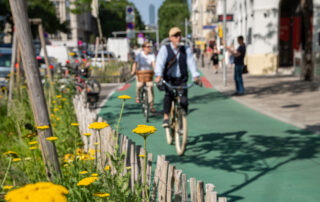
Austria’s best cycling infrastructure solutions
Developing good cycling projects requires outstanding role models. Until a few years ago, these were found in the Netherlands or Denmark – but Austria now has a number of standout examples of its own. In this compilation, we present a selection of the best cycling solutions implemented in Austria to date. This collection is not a ranking, but offers [...]

Panel Discussion on Women’s Networks in Cycling in Austria
The annual Cycling Competence Austria Roundtable took place on 23 June in Vienna for the first time as an open forum addressing the visibility and participation of women in the cycling sector and related fields. Under the title “More Women. More Perspectives. More Cycling Competence,” a high-profile panel of experts from Cycling Competence Austria member [...]
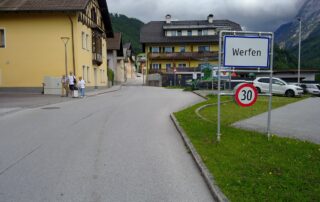
30 km/h Speed Limits in Austrian Municipalities: Evidence and Practice
Speed reduction is a key measure for improving road safety for all road users – with particularly strong benefits for people walking and cycling. The Radkompetenz member Radlobby Austria documents examples of municipalities with 30 km/h speed limits in its collection “Tempo-30-Orte”. The updated dataset now includes 386 municipalities and shows that area-wide speed reductions [...]
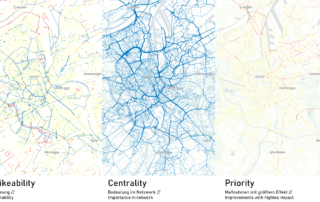
Bikeability Models as a Tool for Cycling Network Planning
What makes a street or a city bicycle-friendly – and who decides? Bikeability assessment models provide comparable, data-driven answers to these questions. A look behind the scenes at the Mobility Lab of the Department of Geoinformatics (Z_GIS) at the University of Salzburg, a member of Cycle Competence Austria, shows how geospatial methods support cycling planning, [...]

Active2Public Transport: Integrating Cycling and Public Transport in Practice
The EU project Active2Public Transport (A2PT) investigated how active mobility and public transport can be more effectively combined. Project partners included members of Radkompetenz Austria: BMIMI klimaaktiv mobil, the Mobility Centre Burgenland, and Verracon. A key component of the project was a hands-on pilot scheme titled “Give your car a break”, which allowed participants to [...]

Vienna redesigns the Ringstraße for walking and cycling
With thousands of pedestrians and cyclists every day, Vienna’s Ringstraße is one of the most heavily used urban street spaces in Austria. It brings together high levels of walking and cycling traffic, dense public transport services and major historic urban spaces within a very constrained corridor. The shared pedestrian and cycling paths along the Ring are increasingly reaching their capacity [...]
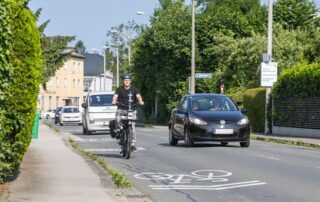
Evidence-based cycling planning: findings from the Nußdorferstraße real-world laboratory
How do road markings affect overtaking behaviour around cyclists? The research bicycle used by Salzburg Research makes it possible to measure this objectively. Results from the Nußdorferstraße real-world laboratory show that targeted markings, particularly wide multi-purpose lanes with a narrow central carriageway, increase the overtaking distance between motor vehicles and cyclists. […]
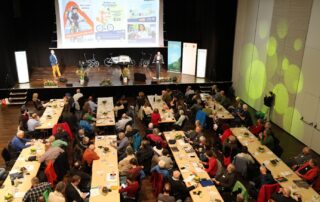
Expertise at the 2026 Cycling Network Meeting in Upper Austria
From network planning and traffic calming to cost-effective solutions in rural areas: in early March 2026, the Upper Austria Cycling Network Meeting provided a wealth of inspiration for promoting cycling in local communities. Practical examples from several federal states demonstrated what is possible when projects are implemented with vision, courage and determination, and with the involvement of the local [...]
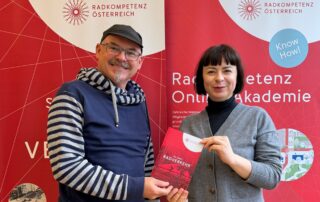
New coordination office for Radkompetenz Österreich
The Radkompetenz Österreich platform was founded in 2014 and has been coordinated by Alec Hager ever since. After twelve years of dedicated development work, he is handing over this role to Climate Alliance Upper Austria, which has extensive experience in promoting cycling. Irene Wögerer from Climate Alliance took over the coordination role at the beginning [...]
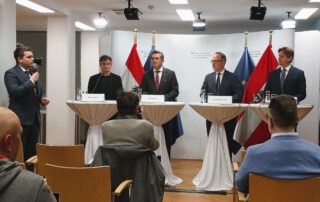
Amendment to the Road Traffic Regulations with new bicycle definitions and video surveillance
On October 21, the draft amendment to the Road Traffic Regulations (StVO) was presented to the press by Mobility Minister Peter Hanke. The most important points are the introduction of video surveillance for traffic calming measures and new rules for e-scooters and e-bikes that are not pedal-assisted. There are no plans to make helmets mandatory for e-bikes. Open questions [...]