
VCÖ Mobility Award 2025 for cycling projects from Vienna to Lienz
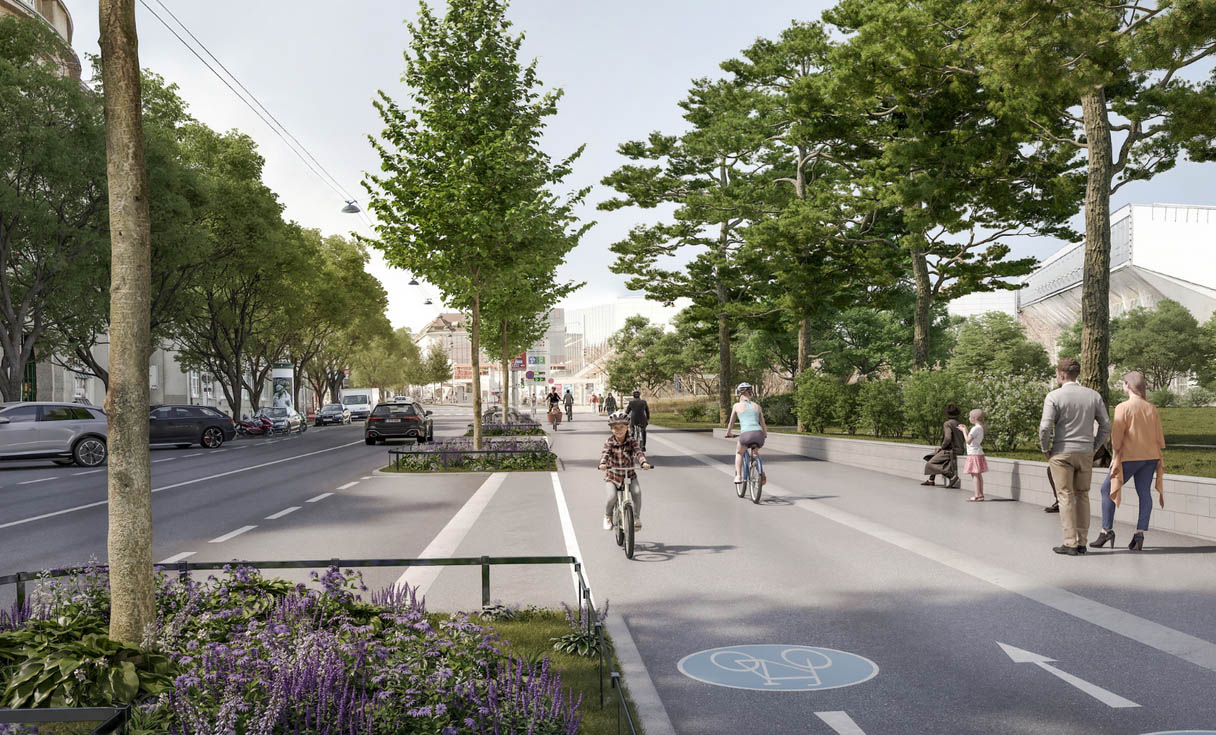
The VCÖ Mobility Award 2025 was selected under the motto “Fit for the future for cities and rural areas” in twelve nationwide categories and in nine federal state categories. Among others, the Cycle Competence members Mobilitätsagentur Wien were delighted to receive the award for top project in the category “Walking and Cycling,” and con.sens mobilitätsdesign received an award for the redevelopment of Praterstraße. We provide an Austria-wide overview of all award-winning bicycle-related projects: corporate mobility management, urban district planning, bicycle services, and awareness-raising measures.
Vienna’s cycling offensive honored
Almost 100 km of cycling infrastructure has been implemented in Vienna over the last five years, and we have reported on the highlights (e.g., the 2024 cycle path construction program). These include the Radhighway Nord (Lasallestraße, Praterstraße, Wagramerstraße), the Radhighway Süd (Argentinierstraße, Herndlgasse), and the expansion of the Radachse Wien West. Investments totaling 130 million euros were made by the City of Vienna with the support of the klimaaktiv mobil subsidy from the Ministry of Climate Protection BMK. Traffic calming and the accompanying creation of green space not only enable comfortable and safe bicycle mobility, but also increase the quality of life.

The success of the new cycling infrastructure is reflected in usage patterns: 11% of journeys in the federal capital are currently made by bicycle—a figure that is steadily rising, as modal split surveys show. In 2024, 11.4 million cyclists were counted at permanent bicycle counting stations.

Awarded for Praterstraße: Florian Kratochwil (con.sens Verkehrsplanung, second from left) next to Christof Hermann (ÖBB-Personenverkehr AG), Robert Luger (3:0 Landschaftsarchitektur), City Councilor Ulli Sima, Simon Tschannett (weatherpark), and Christian Gratzer (VCÖ). Photo: City of Vienna/Fürthner
Taking the motto “Fit for the future for city and countryside” at face value
Cycling projects in several federal states were awarded this year’s title for infrastructure measures connecting city and countryside: breaking down barriers and closing gaps in the cycle path network was the aim in the municipalities of Gallneukirchen and the city of Lienz, for example. The latter has embarked on a project to create a continuous cycle path network with twelve sections by 2026 in the planning association comprising the city and 14 surrounding municipalities. The aim is to improve connections to town centers and stops and to implement improved winter maintenance services.

In the photo, from left to right: VCÖ expert Michael Schwendinger, LR René Zumtobel, Harald Haider (Radwege für Osttirol association) and Oskar Januschke (Head of City Marketing Lienz) with Michael Mangeng, Head of Asset Management West at ÖBB-Infrastruktur AG
The award-winning mobility concept in Gallneukirchen (Upper Austria) includes the continuation of the main cycle route to Engerwitzdorf, improved conditions in the city through traffic calming measures at school centers, new 30 km/h zones, and sidewalk connections.
Corporate mobility management: Active at work
The Ordensklinikum Linz is encouraging its employees to cycle to work. To this end, the Elisabethinen parking facilities have been tripled to 211 spaces, city bikes are available for business trips, charging stations for e-bikes have been expanded, and a free bike check is held twice a year for the staff. For those who cannot travel by bike, an app-based carpooling platform offers alternative options. Starting this October, the Jobrad initiative will also be launched as an incentive for bicycle mobility.
With its in-house “Mobility Services” organizational unit, the Lower Austria-based company Welser Profile took first place at the state level, committing to a distinctly holistic approach to mobility. Since its launch in 2023, subsidized lease bikes have been made available to 400 employees. Awareness-raising measures to motivate environmentally friendly employee mobility are communicated via an app.
Gamification for sustainable commuting to school
Awareness-raising measures in the mobility behavior of young people require creative incentives. In Burgenland, 110 students were chosen as school route detectives by Cycle Competence member Mobilitätszentrale Burgenland and confronted with exciting puzzles on their way to school. The aim of the campaign, entitled “FAIRlagern,” was to increase motivation to walk or cycle short distances in a playful way. Saving money and improving fitness were among the benefits of climate-friendly transportation in Eisenstadt, Güssing, and Neufeld, along with fewer parent taxis. The result: 28% more active journeys to school.

Cycle Competence member Christine Zopf-Renner (head of the Burgenland Mobility Center, second from left) next to Provincial Transport Minister Heinrich Dorner, Altan Sahin (senior expert – Austrian Energy Agency), VCÖ spokesperson Christian Gratzer, Christof Hermann (regional manager, ÖBB Passenger Transport), and Andreas Ecker (Eastern Region Transport Association – VOR). Photo: Burgenland Provincial Media Service
Cycling services in urban areas
Creating services and expanding usage is the motto for bicycle-friendly mobility in urban areas. In addition to the climate-friendly aspects, the award winners in the cities of Salzburg and Innsbruck also emphasize the social dimension of bicycle mobility. In Tyrol’s capital, the maintenance of the fleet, which has now grown to 560 city bikes, is handled by the maintenance service of the socio-economic enterprise WAMS. The comprehensive network of 52 return stations has doubled the number of kilometers traveled annually: since its launch in 2021, 1.6 million kilometers have been covered with the city bikes. Cycling courses for women in Mozart’s city, on the other hand, are designed to promote social participation and health, while at the same time increasing the use of bicycles for everyday journeys. The initiative was launched in cooperation with the preventive medicine company AVOS.

Award for women’s cycling courses: Ursula Witzmann-Müller (UMW.Mobilität, third from right) next to Deputy Governor Stefan Schnöll, Eva Hammer-Schwaighofer (AVOS) and Ulrike Stefflbauer (Team Vielfalt Salzburg) as well as Michael Schwendinger (VCÖ), Bernhard Auinger (Mayor of Salzburg) and Gernot Huber (Regional Manager, ÖBB-Personenverkehr AG). Photo: State of Salzburg/Neumayr/Laux
District planning focuses on bike-friendly design
From the outset, the development of residential and living space in the Graumann district in Traun, Upper Austria, has focused strongly on making bike- and pedestrian-friendly spaces and infrastructure more attractive and integrated into the planning. Here, too, the aim was to make everyday errands more climate-friendly through these measures. Forty percent of the area was unsealed and greened, and more bicycle parking facilities were provided than required, while at the same time reducing the number of mandatory car parking spaces. In addition, a wide range of shared vehicles, including bicycles, e-bikes, and electric transport bikes, was created. The plan also included the construction of facilities for everyday needs within walking distance.
Rendering above: ZoomVP/Fahrrad Wien
Cycling Competence Members in this article:
More articles with this member:
[crp]
Share this article:
VCÖ Mobility Award 2025 for cycling projects from Vienna to Lienz
Share this article:
The VCÖ Mobility Award 2025 was selected under the motto “Fit for the future for cities and rural areas” in twelve nationwide categories and in nine federal state categories. Among others, the Cycle Competence members Mobilitätsagentur Wien were delighted to receive the award for top project in the category “Walking and Cycling,” and con.sens mobilitätsdesign received an award for the redevelopment of Praterstraße. We provide an Austria-wide overview of all award-winning bicycle-related projects: corporate mobility management, urban district planning, bicycle services, and awareness-raising measures.
Vienna’s cycling offensive honored
Almost 100 km of cycling infrastructure has been implemented in Vienna over the last five years, and we have reported on the highlights (e.g., the 2024 cycle path construction program). These include the Radhighway Nord (Lasallestraße, Praterstraße, Wagramerstraße), the Radhighway Süd (Argentinierstraße, Herndlgasse), and the expansion of the Radachse Wien West. Investments totaling 130 million euros were made by the City of Vienna with the support of the klimaaktiv mobil subsidy from the Ministry of Climate Protection BMK. Traffic calming and the accompanying creation of green space not only enable comfortable and safe bicycle mobility, but also increase the quality of life.
The success of the new cycling infrastructure is reflected in usage patterns: 11% of journeys in the federal capital are currently made by bicycle—a figure that is steadily rising, as modal split surveys show. In 2024, 11.4 million cyclists were counted at permanent bicycle counting stations.
Awarded for Praterstraße: Florian Kratochwil (con.sens Verkehrsplanung, second from left) next to Christof Hermann (ÖBB-Personenverkehr AG), Robert Luger (3:0 Landschaftsarchitektur), City Councilor Ulli Sima, Simon Tschannett (weatherpark), and Christian Gratzer (VCÖ). Photo: City of Vienna/Fürthner
Taking the motto “Fit for the future for city and countryside” at face value
Cycling projects in several federal states were awarded this year’s title for infrastructure measures connecting city and countryside: breaking down barriers and closing gaps in the cycle path network was the aim in the municipalities of Gallneukirchen and the city of Lienz, for example. The latter has embarked on a project to create a continuous cycle path network with twelve sections by 2026 in the planning association comprising the city and 14 surrounding municipalities. The aim is to improve connections to town centers and stops and to implement improved winter maintenance services.
In the photo, from left to right: VCÖ expert Michael Schwendinger, LR René Zumtobel, Harald Haider (Radwege für Osttirol association) and Oskar Januschke (Head of City Marketing Lienz) with Michael Mangeng, Head of Asset Management West at ÖBB-Infrastruktur AG
The award-winning mobility concept in Gallneukirchen (Upper Austria) includes the continuation of the main cycle route to Engerwitzdorf, improved conditions in the city through traffic calming measures at school centers, new 30 km/h zones, and sidewalk connections.
Corporate mobility management: Active at work
The Ordensklinikum Linz is encouraging its employees to cycle to work. To this end, the Elisabethinen parking facilities have been tripled to 211 spaces, city bikes are available for business trips, charging stations for e-bikes have been expanded, and a free bike check is held twice a year for the staff. For those who cannot travel by bike, an app-based carpooling platform offers alternative options. Starting this October, the Jobrad initiative will also be launched as an incentive for bicycle mobility.
With its in-house “Mobility Services” organizational unit, the Lower Austria-based company Welser Profile took first place at the state level, committing to a distinctly holistic approach to mobility. Since its launch in 2023, subsidized lease bikes have been made available to 400 employees. Awareness-raising measures to motivate environmentally friendly employee mobility are communicated via an app.
Gamification for sustainable commuting to school
Awareness-raising measures in the mobility behavior of young people require creative incentives. In Burgenland, 110 students were chosen as school route detectives by Cycle Competence member Mobilitätszentrale Burgenland and confronted with exciting puzzles on their way to school. The aim of the campaign, entitled “FAIRlagern,” was to increase motivation to walk or cycle short distances in a playful way. Saving money and improving fitness were among the benefits of climate-friendly transportation in Eisenstadt, Güssing, and Neufeld, along with fewer parent taxis. The result: 28% more active journeys to school.
Cycle Competence member Christine Zopf-Renner (head of the Burgenland Mobility Center, second from left) next to Provincial Transport Minister Heinrich Dorner, Altan Sahin (senior expert – Austrian Energy Agency), VCÖ spokesperson Christian Gratzer, Christof Hermann (regional manager, ÖBB Passenger Transport), and Andreas Ecker (Eastern Region Transport Association – VOR). Photo: Burgenland Provincial Media Service
Cycling services in urban areas
Creating services and expanding usage is the motto for bicycle-friendly mobility in urban areas. In addition to the climate-friendly aspects, the award winners in the cities of Salzburg and Innsbruck also emphasize the social dimension of bicycle mobility. In Tyrol’s capital, the maintenance of the fleet, which has now grown to 560 city bikes, is handled by the maintenance service of the socio-economic enterprise WAMS. The comprehensive network of 52 return stations has doubled the number of kilometers traveled annually: since its launch in 2021, 1.6 million kilometers have been covered with the city bikes. Cycling courses for women in Mozart’s city, on the other hand, are designed to promote social participation and health, while at the same time increasing the use of bicycles for everyday journeys. The initiative was launched in cooperation with the preventive medicine company AVOS.
Award for women’s cycling courses: Ursula Witzmann-Müller (UMW.Mobilität, third from right) next to Deputy Governor Stefan Schnöll, Eva Hammer-Schwaighofer (AVOS) and Ulrike Stefflbauer (Team Vielfalt Salzburg) as well as Michael Schwendinger (VCÖ), Bernhard Auinger (Mayor of Salzburg) and Gernot Huber (Regional Manager, ÖBB-Personenverkehr AG). Photo: State of Salzburg/Neumayr/Laux
District planning focuses on bike-friendly design
From the outset, the development of residential and living space in the Graumann district in Traun, Upper Austria, has focused strongly on making bike- and pedestrian-friendly spaces and infrastructure more attractive and integrated into the planning. Here, too, the aim was to make everyday errands more climate-friendly through these measures. Forty percent of the area was unsealed and greened, and more bicycle parking facilities were provided than required, while at the same time reducing the number of mandatory car parking spaces. In addition, a wide range of shared vehicles, including bicycles, e-bikes, and electric transport bikes, was created. The plan also included the construction of facilities for everyday needs within walking distance.
Rendering above: ZoomVP/Fahrrad Wien
Cycling Competence Members in this article:
More articles with this member:
[crp]