
Report Active Mobility: Trends in Cycling in Austria

How have cycling and walking developed in Austria in recent years? The Active Mobility Report now provides answers. It summarizes the results of the second nationwide survey on active mobility from 2023 and compares them to the first survey conducted in 2021. The report also reveals surprising developments compared to the first survey: declining popularity among young people, fewer bicycles owned per household. Expected, however, are the barriers to increased cycling, such as reluctance to ride in the rain and the ongoing e-bike boom. Here, we present a summary focusing on cycling.
Declining trend among young cyclists
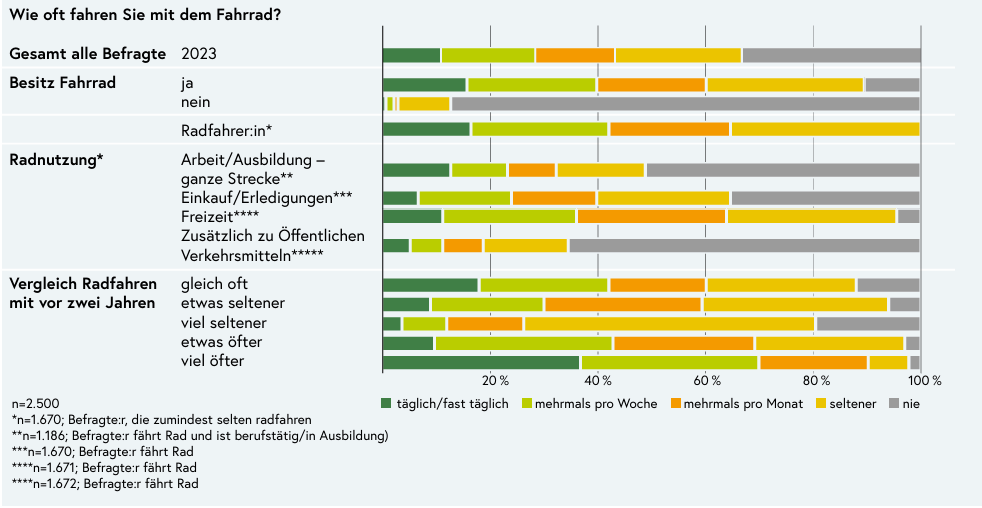
The survey shows that 27% of respondents in 2023 rode a bike daily or several times a week. However, this is significantly fewer people than in 2021, when it was 38%. Could the cycling trend during the pandemic explain this? It is also noticeable that bike usage is declining among the younger generation. The proportion of young people who never cycle has nearly doubled since 2021: from 15% to 36%.
Frequency of cycling by age and federal state
A comparison with the 2021 survey clearly shows the declining popularity of cycling among 16- to 29-year-olds — dropping from 87% to 78%. This development indicates that cycling mobility especially needs to be promoted for this age group.
The graphic also shows that cycling is particularly common in Salzburg, Tyrol, and Vorarlberg. People in Vienna and those over 60 use bicycles the least.
Barriers to increased cycling identified

The survey also highlights the main barriers to increased cycling. In addition to infrastructural shortcomings, practical everyday requirements, physical limitations, and safety concerns play a central role in the decision not to use a bicycle.
Analyses of trip purposes and weather conditions show that cycling is primarily used for leisure trips, shopping, or running errands. Around 40% of respondents are not deterred from cycling even by low temperatures. However, the willingness to ride a bike in the rain (25%) or snow (14%) is significantly lower.
Multimodal mobility

The survey provides interesting insights into combined mobility: 35% of cyclists occasionally combine cycling with public transportation, while 65% rely solely on their bike. This combination is especially popular among younger people and is noticeably more common in Vienna, Salzburg, and Vorarlberg than in other federal states.
Bicycle equipment: standard in many Austrian households


Cycling Competence Members in this article:
More articles with this member:
[crp]
Share this article:
Report Active Mobility: Trends in Cycling in Austria
Share this article:
How have cycling and walking developed in Austria in recent years? The Active Mobility Report now provides answers. It summarizes the results of the second nationwide survey on active mobility from 2023 and compares them to the first survey conducted in 2021. The report also reveals surprising developments compared to the first survey: declining popularity among young people, fewer bicycles owned per household. Expected, however, are the barriers to increased cycling, such as reluctance to ride in the rain and the ongoing e-bike boom. Here, we present a summary focusing on cycling.
Declining trend among young cyclists
The survey shows that 27% of respondents in 2023 rode a bike daily or several times a week. However, this is significantly fewer people than in 2021, when it was 38%. Could the cycling trend during the pandemic explain this? It is also noticeable that bike usage is declining among the younger generation. The proportion of young people who never cycle has nearly doubled since 2021: from 15% to 36%.
Frequency of cycling by age and federal state
A comparison with the 2021 survey clearly shows the declining popularity of cycling among 16- to 29-year-olds — dropping from 87% to 78%. This development indicates that cycling mobility especially needs to be promoted for this age group.
The graphic also shows that cycling is particularly common in Salzburg, Tyrol, and Vorarlberg. People in Vienna and those over 60 use bicycles the least.
Barriers to increased cycling identified
The survey also highlights the main barriers to increased cycling. In addition to infrastructural shortcomings, practical everyday requirements, physical limitations, and safety concerns play a central role in the decision not to use a bicycle.
Analyses of trip purposes and weather conditions show that cycling is primarily used for leisure trips, shopping, or running errands. Around 40% of respondents are not deterred from cycling even by low temperatures. However, the willingness to ride a bike in the rain (25%) or snow (14%) is significantly lower.
Multimodal mobility
The survey provides interesting insights into combined mobility: 35% of cyclists occasionally combine cycling with public transportation, while 65% rely solely on their bike. This combination is especially popular among younger people and is noticeably more common in Vienna, Salzburg, and Vorarlberg than in other federal states.
Bicycle equipment: standard in many Austrian households
Cycling Competence Members in this article:
More articles with this member:
[crp]