
Research project tests multi-purpose lanes on rural roads
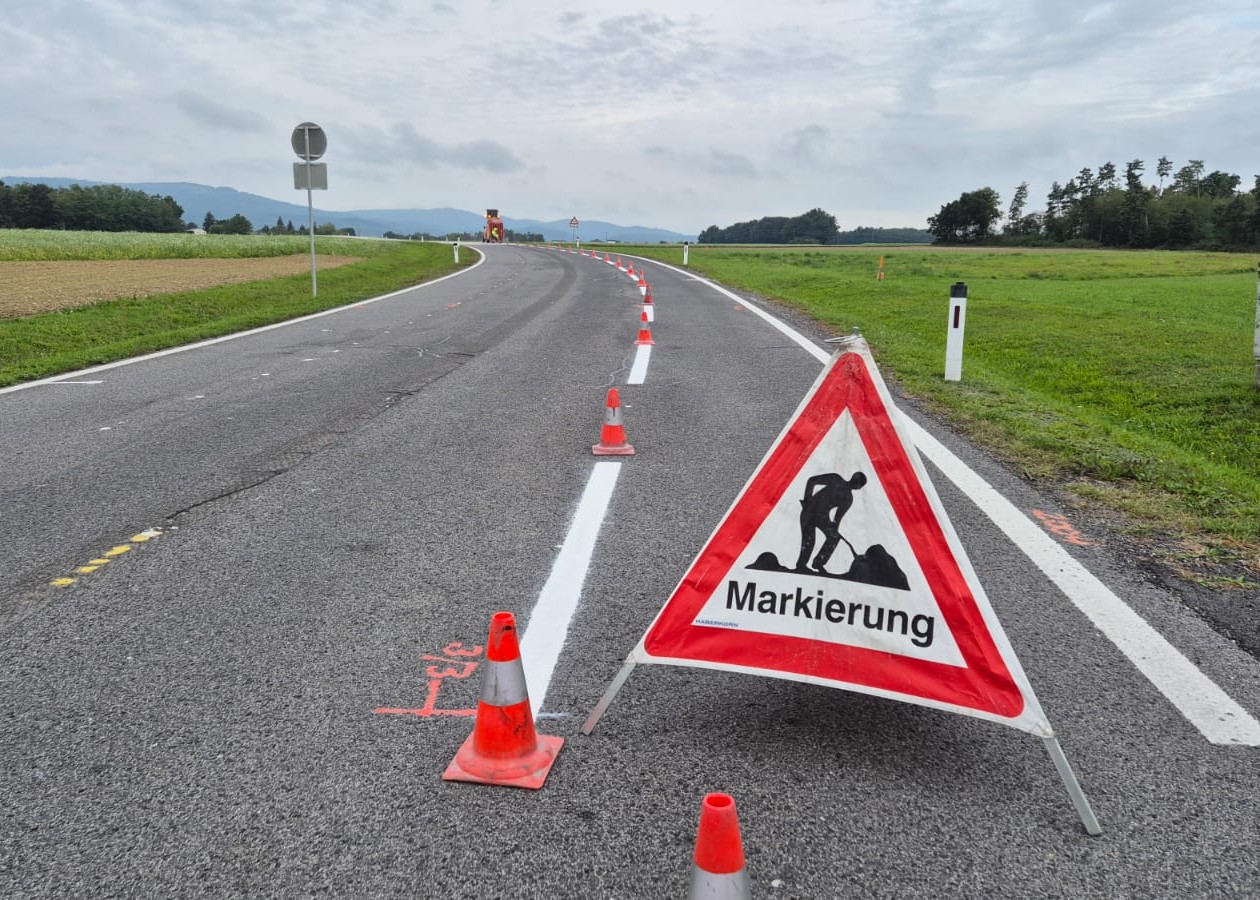
Can multi-purpose lanes with narrow central lanes increase safety for cyclists on open roads? This question is being investigated by Cycle Competence members Salzburg Research and con.sens mobilitätsdesign in the ‘MZSFreiland’ research project commissioned by the Ministry of Transport in collaboration with the Austrian Road Safety Board (KFV). The first test routes have already been marked out in Burgenland, Carinthia and Vorarlberg.
This innovative special solution would make it possible to close gaps in the cycle path network where structural solutions are not feasible. The investigations are accompanied by state-of-the-art sensor technology and social science surveys. The aim is to create an evidence-based foundation for future planning and to take an important step towards safer, climate-friendly mobility. Austria is thus moving closer to a concept known internationally as ‘2minus1 road’, which is used in Denmark, Sweden and Belgium, for example.
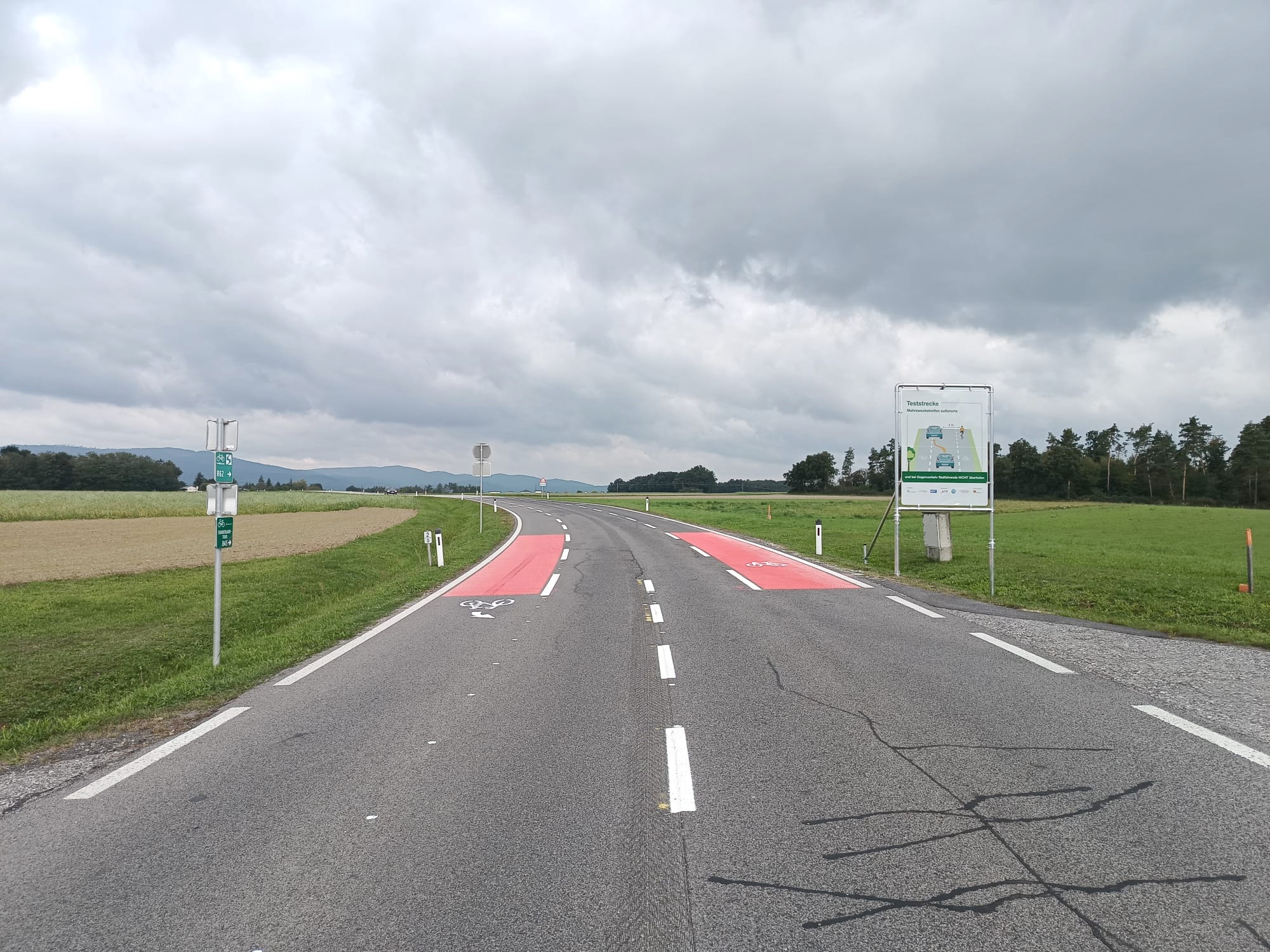
One of the test routes in Burgenland with an information board explaining the correct behaviour (photo: Bernd Wessely/Land Burgenland)
Closing gaps in the cycle network where structural solutions are not possible
In order to achieve Austria’s climate targets, more active mobility is needed – even outside cities. However, many rural roads lack safe facilities for cyclists. The project is therefore testing new approaches to closing gaps in the cycle path network where structurally separate cycle paths are not feasible due to local conditions. Multi-purpose lanes with a narrow central carriageway are considered a promising model, which is now being scientifically investigated as part of the research project.
Multi-purpose lanes are specially marked areas of the roadway that are primarily intended for bicycle traffic, but may also be used by motor vehicles under certain conditions. According to the guidelines and regulations for road construction (RVS) 03.02.13, multi-purpose lanes with a reduced core roadway (less than 4.5 metres wide) may only be used in Austria at a maximum permissible speed of 30 km/h. This means that their use on open roads is currently not permitted.
A traffic trial involving three test routes in Burgenland, Carinthia and Vorarlberg is investigating safety, acceptance and limits of use. The findings will be incorporated into specific recommendations for traffic planning and the further development of the RVS guidelines. The research team aims to provide evidence-based foundations for the future implementation of cycle facilities even in locations where structural solutions were previously not possible.
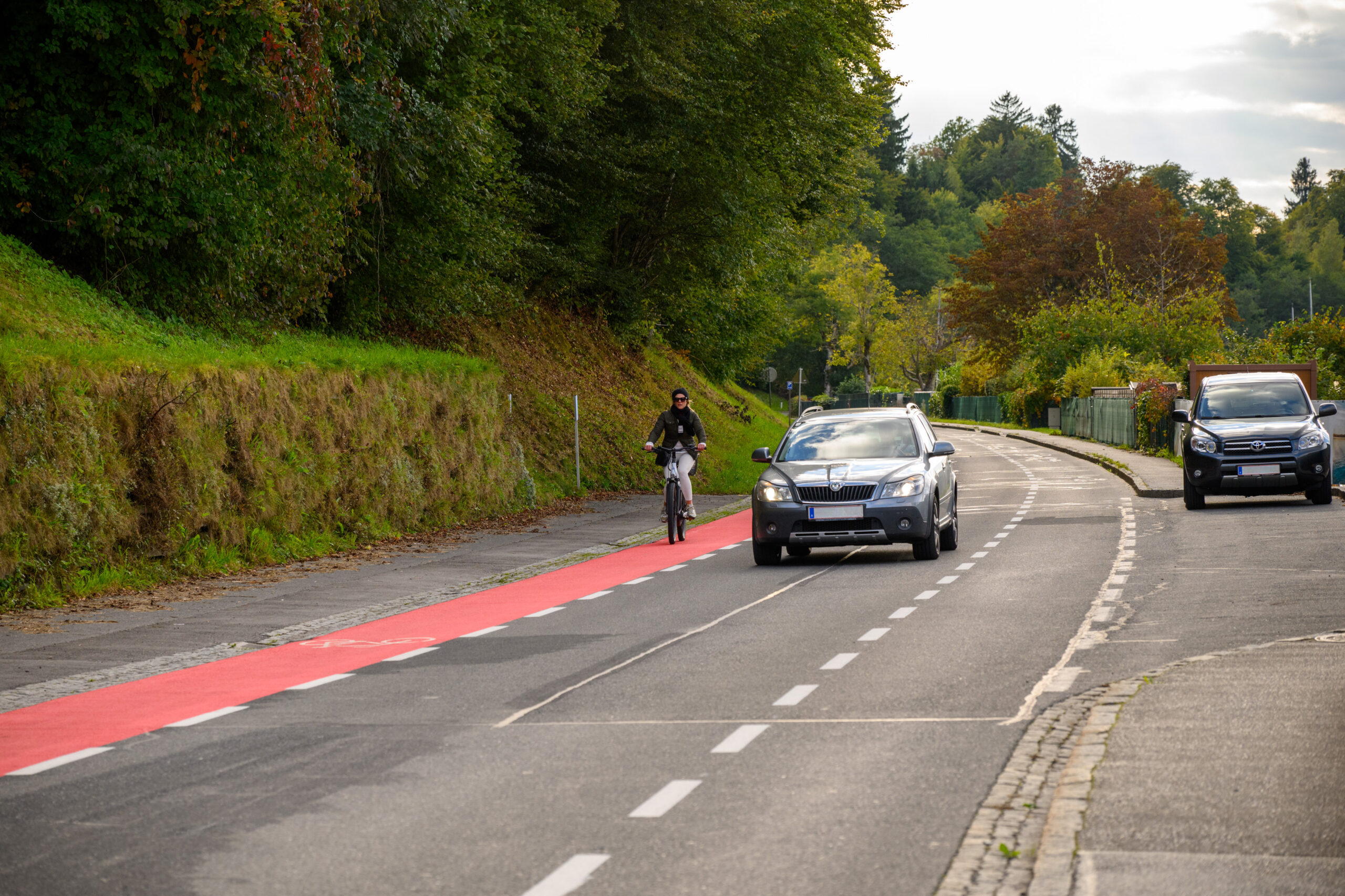
Overtaking manoeuvre on one of the test tracks (photo: Salzburg Research/Thomas Hude)
High tech meets social research
State-of-the-art measurement methods are used to support the scientific research. Salzburg Research uses the Holoscene Bike research bicycle, which is equipped with LiDAR and video sensors, to precisely record overtaking manoeuvres between motor vehicles and cyclists. In addition, side radars measure traffic volumes, speeds and vehicle types.
In addition to technical analyses, the Austrian Road Safety Board (KFV) uses social science methods. Test subjects ride the test tracks and evaluate their sense of safety and their experiences. Surveys are also conducted in the respective regions. The focus is not only on objective safety, but also on subjective perceptions of safety and acceptance among the population.
Three pilot routes in three federal states
In Burgenland, a gap in the cycle network is being closed on the P456 Weppersdorfer street between Weppersdorf and Lackenbach. Over a length of 1.1 kilometres, a multi-purpose lane 1.80 metres wide on both sides and a narrow central carriageway three metres wide have been marked out. At the beginning and end of the route, red road markings and information boards indicate the changed infrastructure.

Start of the Burgenland pilot route at the eastern end of the P456 Weppersdorfer street near Lackenbach (photo: Province of Burgenland/Bernd Wessely)
In Carinthia, a section of the L96 Wörthersee Südufer street was selected that is particularly heavily used by cyclists. On a stretch of around one kilometre between Auen and Oberdellach, multi-purpose lanes 1.50 metres wide were marked on both sides, while the main carriageway remains around three metres wide. Additional markings and traffic signs warn of the danger of car doors opening in the area of a beach café.
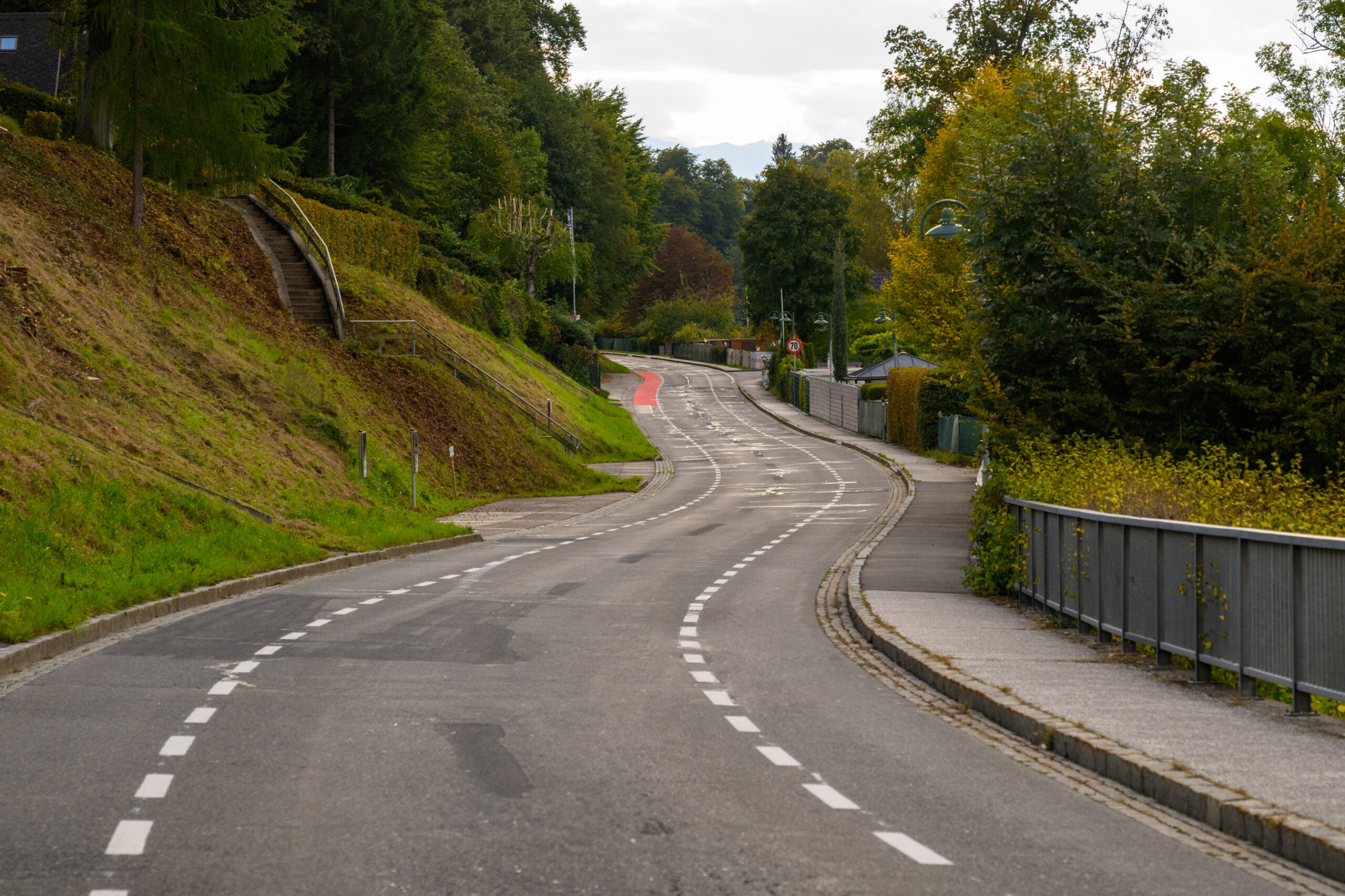
Multi-purpose lane on the pilot route in Carinthia in the area of the L96 Wörthersee Südufer street with a speed limit of 70 km/h (photo: Salzburg Research/Thomas Hude)
In Vorarlberg, an uphill section of the L50 Montfort street between the Götzis and St. Arbogast town signs is being investigated. Further details are currently being coordinated.
All test routes have been or will be re-marked in September or October 2025. As part of the project, the project team is also providing information material for the various road users with recommendations on how to behave correctly on the sections of road. After an acclimatisation period of at least one month, sensor measurements, road tests and surveys will begin. The test phase will last until August 2026. The results will be published after the end of the project in autumn 2026.
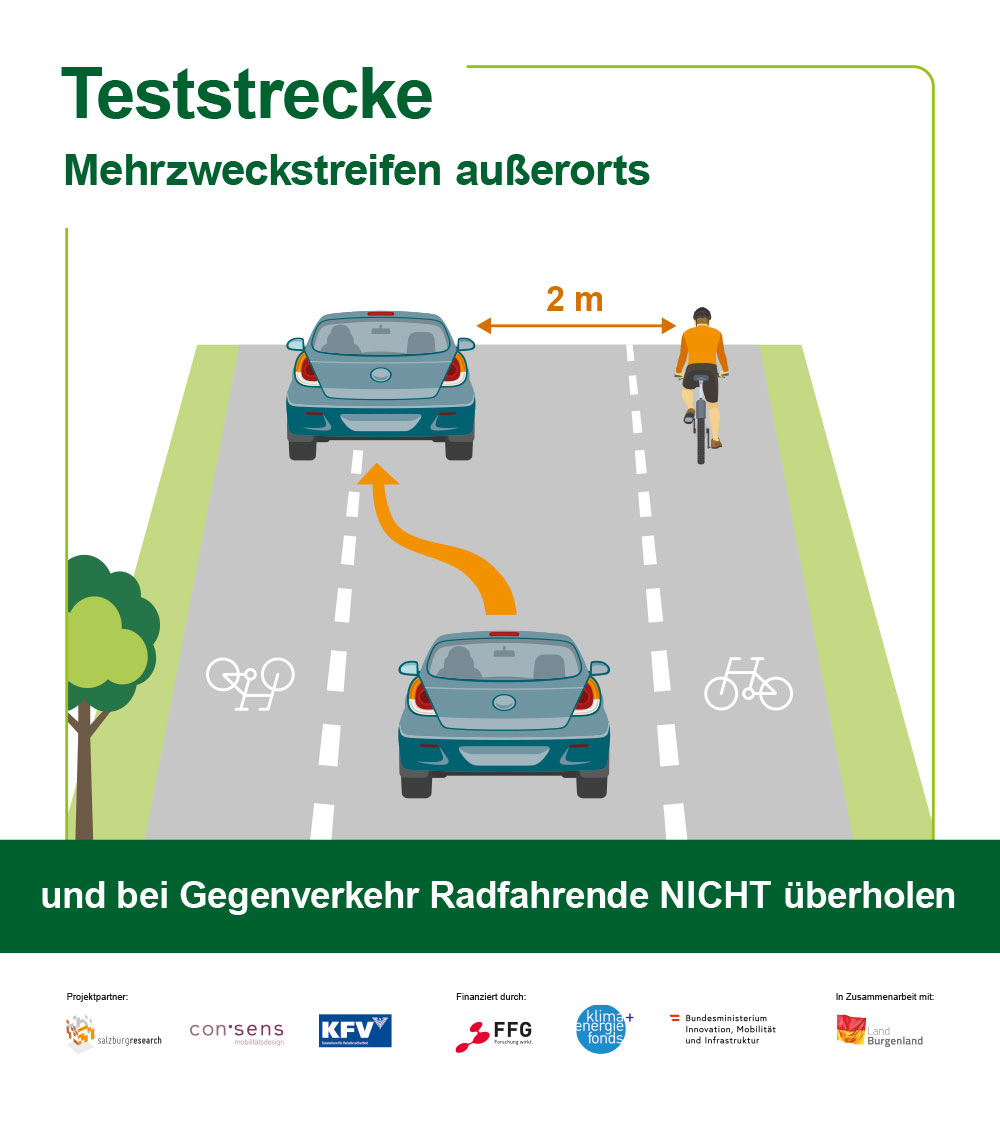
Information board for road users at the start of the test route (© Salzburg Research)
About the MZSFreiland project
The MZSFreiland research project is the first in Austria to investigate whether so-called multi-purpose lanes with a narrow central roadway can also be used sensibly and safely on open roads to close gaps in the cycle network. This type of infrastructure is already established in countries such as the Netherlands, Denmark and France.
The project is supported by a multidisciplinary consortium. Salzburg Research is responsible for project coordination and data collection using sensor technology. The con.sens mobilitätsdesign office contributes its expertise in bicycle traffic planning and policy development. The Austrian Road Safety Board (KFV) is conducting safety-related analyses and contributing its many years of experience in road safety research. This project is funded by the Climate and Energy Fund and is being carried out as part of the Zero Emission Mobility plus 2024 programme.
The pilot routes in the individual federal states are being implemented in cooperation with the Office of the Burgenland Provincial Government, Department 5 – Building Authority and the Burgenland Mobility Centre, the Office of the Carinthian Provincial Government, Department 7 – Economy, Tourism and Mobility, and the Office of the Vorarlberg Provincial Government, Department of Road Construction (VIIb).
Second research project: MehrzweckSicher
Another Cycle Competence member is dedicated to the topic of investigating multi-purpose lanes in open country with reduced central carriageways: the AIT Austrian Institute of Technology is working with subcontractors ÖAMTC and INTEGRAL Markt- und Meinungsforschung on the FFG research project “MehrzweckSicher“. The test routes are still being coordinated with the federal states of Tyrol, Burgenland and Carinthia, and the surveys will start in spring 2026. The AIT research team is investigating traffic behaviour using a before-and-after analysis. In addition, three routes are being modelled using microsimulation in order to define the limits of application more precisely. An Austria-wide survey is being conducted to gauge acceptance of the measure. We will report on this in the next newsletter!
Further information on ‘MZSFreiland’
Link to the KfV online survey: LINK
Details on the Holoscene Bike research bicycle for measuring overtaking manoeuvres between cyclists and motor vehicles: ARTICLE
Contact: Sven Leitinger, Project Manager at Salzburg Research: EMAIL
Cycling Competence Members in this article:
More articles with this member:
[crp]
Share this article:
Research project tests multi-purpose lanes on rural roads
Share this article:
Can multi-purpose lanes with narrow central lanes increase safety for cyclists on open roads? This question is being investigated by Cycle Competence members Salzburg Research and con.sens mobilitätsdesign in the ‘MZSFreiland’ research project commissioned by the Ministry of Transport in collaboration with the Austrian Road Safety Board (KFV). The first test routes have already been marked out in Burgenland, Carinthia and Vorarlberg.
This innovative special solution would make it possible to close gaps in the cycle path network where structural solutions are not feasible. The investigations are accompanied by state-of-the-art sensor technology and social science surveys. The aim is to create an evidence-based foundation for future planning and to take an important step towards safer, climate-friendly mobility. Austria is thus moving closer to a concept known internationally as ‘2minus1 road’, which is used in Denmark, Sweden and Belgium, for example.
One of the test routes in Burgenland with an information board explaining the correct behaviour (photo: Bernd Wessely/Land Burgenland)
Closing gaps in the cycle network where structural solutions are not possible
In order to achieve Austria’s climate targets, more active mobility is needed – even outside cities. However, many rural roads lack safe facilities for cyclists. The project is therefore testing new approaches to closing gaps in the cycle path network where structurally separate cycle paths are not feasible due to local conditions. Multi-purpose lanes with a narrow central carriageway are considered a promising model, which is now being scientifically investigated as part of the research project.
Multi-purpose lanes are specially marked areas of the roadway that are primarily intended for bicycle traffic, but may also be used by motor vehicles under certain conditions. According to the guidelines and regulations for road construction (RVS) 03.02.13, multi-purpose lanes with a reduced core roadway (less than 4.5 metres wide) may only be used in Austria at a maximum permissible speed of 30 km/h. This means that their use on open roads is currently not permitted.
A traffic trial involving three test routes in Burgenland, Carinthia and Vorarlberg is investigating safety, acceptance and limits of use. The findings will be incorporated into specific recommendations for traffic planning and the further development of the RVS guidelines. The research team aims to provide evidence-based foundations for the future implementation of cycle facilities even in locations where structural solutions were previously not possible.
Overtaking manoeuvre on one of the test tracks (photo: Salzburg Research/Thomas Hude)
High tech meets social research
State-of-the-art measurement methods are used to support the scientific research. Salzburg Research uses the Holoscene Bike research bicycle, which is equipped with LiDAR and video sensors, to precisely record overtaking manoeuvres between motor vehicles and cyclists. In addition, side radars measure traffic volumes, speeds and vehicle types.
In addition to technical analyses, the Austrian Road Safety Board (KFV) uses social science methods. Test subjects ride the test tracks and evaluate their sense of safety and their experiences. Surveys are also conducted in the respective regions. The focus is not only on objective safety, but also on subjective perceptions of safety and acceptance among the population.
Three pilot routes in three federal states
In Burgenland, a gap in the cycle network is being closed on the P456 Weppersdorfer street between Weppersdorf and Lackenbach. Over a length of 1.1 kilometres, a multi-purpose lane 1.80 metres wide on both sides and a narrow central carriageway three metres wide have been marked out. At the beginning and end of the route, red road markings and information boards indicate the changed infrastructure.
Start of the Burgenland pilot route at the eastern end of the P456 Weppersdorfer street near Lackenbach (photo: Province of Burgenland/Bernd Wessely)
In Carinthia, a section of the L96 Wörthersee Südufer street was selected that is particularly heavily used by cyclists. On a stretch of around one kilometre between Auen and Oberdellach, multi-purpose lanes 1.50 metres wide were marked on both sides, while the main carriageway remains around three metres wide. Additional markings and traffic signs warn of the danger of car doors opening in the area of a beach café.
Multi-purpose lane on the pilot route in Carinthia in the area of the L96 Wörthersee Südufer street with a speed limit of 70 km/h (photo: Salzburg Research/Thomas Hude)
In Vorarlberg, an uphill section of the L50 Montfort street between the Götzis and St. Arbogast town signs is being investigated. Further details are currently being coordinated.
All test routes have been or will be re-marked in September or October 2025. As part of the project, the project team is also providing information material for the various road users with recommendations on how to behave correctly on the sections of road. After an acclimatisation period of at least one month, sensor measurements, road tests and surveys will begin. The test phase will last until August 2026. The results will be published after the end of the project in autumn 2026.
Information board for road users at the start of the test route (© Salzburg Research)
About the MZSFreiland project
The MZSFreiland research project is the first in Austria to investigate whether so-called multi-purpose lanes with a narrow central roadway can also be used sensibly and safely on open roads to close gaps in the cycle network. This type of infrastructure is already established in countries such as the Netherlands, Denmark and France.
The project is supported by a multidisciplinary consortium. Salzburg Research is responsible for project coordination and data collection using sensor technology. The con.sens mobilitätsdesign office contributes its expertise in bicycle traffic planning and policy development. The Austrian Road Safety Board (KFV) is conducting safety-related analyses and contributing its many years of experience in road safety research. This project is funded by the Climate and Energy Fund and is being carried out as part of the Zero Emission Mobility plus 2024 programme.
The pilot routes in the individual federal states are being implemented in cooperation with the Office of the Burgenland Provincial Government, Department 5 – Building Authority and the Burgenland Mobility Centre, the Office of the Carinthian Provincial Government, Department 7 – Economy, Tourism and Mobility, and the Office of the Vorarlberg Provincial Government, Department of Road Construction (VIIb).
Second research project: MehrzweckSicher
Another Cycle Competence member is dedicated to the topic of investigating multi-purpose lanes in open country with reduced central carriageways: the AIT Austrian Institute of Technology is working with subcontractors ÖAMTC and INTEGRAL Markt- und Meinungsforschung on the FFG research project “MehrzweckSicher“. The test routes are still being coordinated with the federal states of Tyrol, Burgenland and Carinthia, and the surveys will start in spring 2026. The AIT research team is investigating traffic behaviour using a before-and-after analysis. In addition, three routes are being modelled using microsimulation in order to define the limits of application more precisely. An Austria-wide survey is being conducted to gauge acceptance of the measure. We will report on this in the next newsletter!
Further information on ‘MZSFreiland’
Link to the KfV online survey: LINK
Details on the Holoscene Bike research bicycle for measuring overtaking manoeuvres between cyclists and motor vehicles: ARTICLE
Contact: Sven Leitinger, Project Manager at Salzburg Research: EMAIL
Cycling Competence Members in this article:
More articles with this member:
[crp]